The Healthspan Brief · Issue 06 · 15 August 2026
Nothing hurt. That was the problem.
The years after my daughter was born, and the numbers that were sliding the whole time. Plus what to do with the folder you built last week.
Nothing hurt. That was the whole problem.
When my daughter was born, the parts of my life that kept me healthy went first, and none of it was a decision. Sleep became something that happened in fragments. Meals became whatever was fast. Training became a thing I used to do. It wasn’t a bad week. It was two or three years of drift, and I was too busy inside it to call it anything.
There was no event. No flashing lights, no number in red. Just a slow accumulation I could see the moment I bothered to look: weight up, waist up, and the bloodwork quietly sliding. Glucose and insulin creeping. My triglyceride-to-HDL ratio drifting the wrong way. The one that was most obvious was the least clinical of all — my skin was ageing really fast. The body keeps an honest ledger, and mine was showing it on the outside.
The risk that never interrupts you
Issue 03 called metabolic dysfunction the soil the other three risks grow in. This is what that looks like from the inside: it doesn’t hurt. It doesn’t interrupt a meeting. It accumulates, one unremarkable month at a time, until the baseline you’ve drifted to is the new normal and you can’t remember when it changed.
That is exactly what makes it dangerous. Every other risk on the register eventually announces itself. This one grows precisely because nothing forces you to look.
And there is a particular blindness that comes with the job. I was running reviews on investments, the portfolio, even the household logistics. Everything except the asset all of it depended on. I had dashboards for things that mattered far less than this. The one system I never instrumented was the one running all the others.
Why your panel says you’re fine
Here’s the part that reframes the whole thing: it is a circle, and it tightens quietly.
It starts with surplus: more energy coming in than gets burned, meal after meal, year after year — the drift in one sentence. The surplus shows up in your blood as sugar, and sugar can’t just be left there, because persistently elevated glucose does slow, systemic damage. So the body works hard to clear it.
Clearing it is insulin’s job — the hormone that tells your cells to pull sugar out of the blood and store the energy. But cells that have been handling surplus for years start ignoring the instruction, and the pancreas answers the only way it can: more insulin for the same result. And it works. The sugar gets cleared, and your glucose reads normal.
Except too much insulin is bad too, because insulin is a storage signal. Run high, it packs the surplus into the wrong places — the liver, the fat around your organs — and that visceral fat makes the cells more resistant still, which demands yet more insulin. That is the circle. Chronically elevated insulin also does harm of its own: it is a growth signal, and together with visceral fat it is a potent modifiable cancer risk factor.
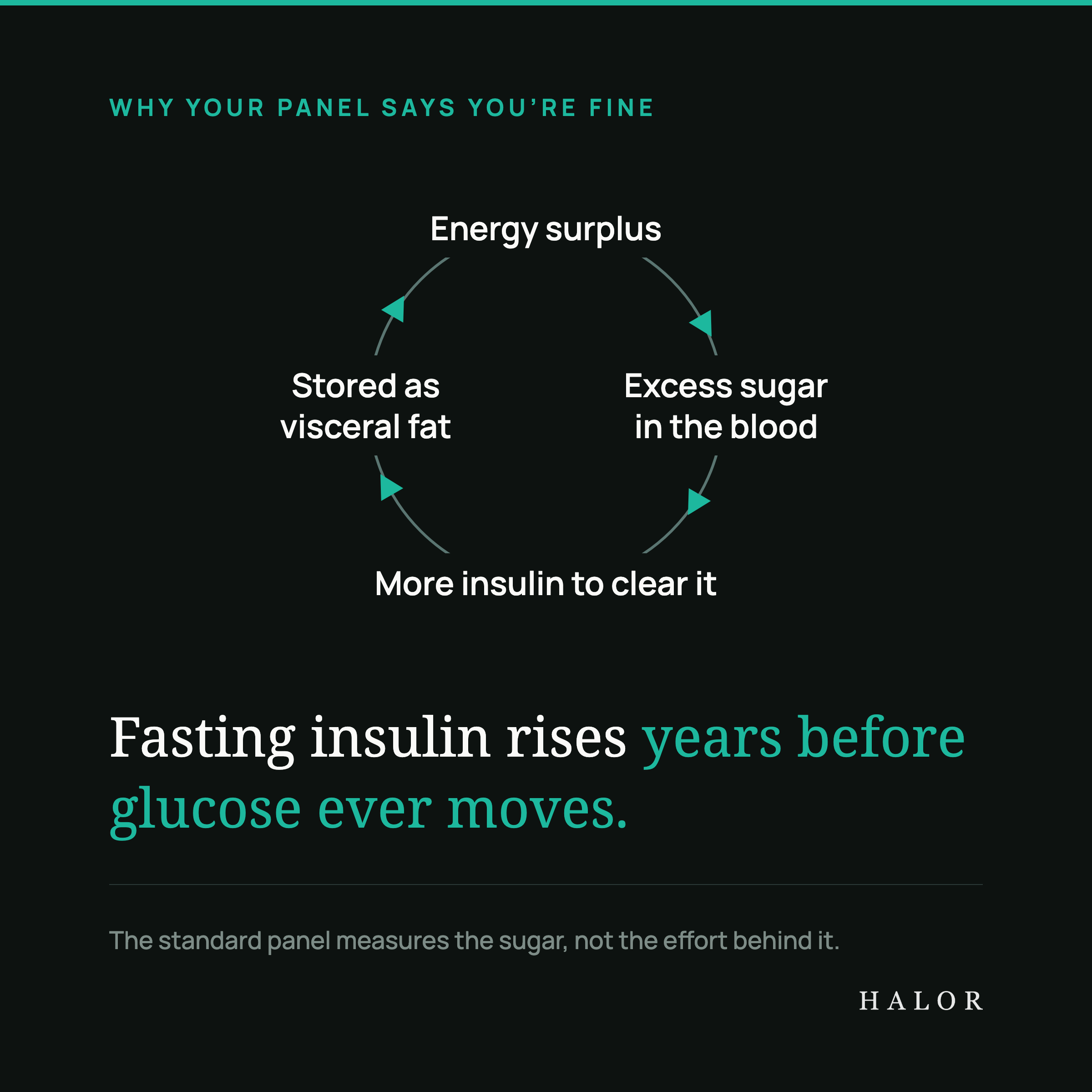
The standard panel sees none of this, because it measures the sugar, not the effort behind it. In many adults on the path to metabolic disease, fasting insulin rises years before glucose ever moves. Read that as an operator: the system is working harder every year to deliver the same output, the report says nothing has changed, and by the time glucose finally drifts out of range, the strain is a decade old.
And it is not only the sugar that runs high. The same surplus circulates as fat too — triglycerides, sitting on every standard panel you have ever had. When they climb, the body is moving more fat than it can store or burn cleanly: the same overloaded system, read from the other side.
What I actually did
I made myself look. I wore a continuous glucose monitor and watched, for the first time, how my own body responded to a meal, to a bad night, to a stressful week. Later a DEXA scan turned “I’ve put on a bit” into four exact numbers, including the visceral fat from Issue 01 that no scale reports.
Then I managed it, unglamorously. Training rebuilt to seven days a week: three strength, three Zone 2, one Zone 5, and stability work every day. Diet run like an experiment until I landed on the boring thing that worked, which was tracking what I ate with a real focus on protein. Sleep improved as far as a working schedule allows, which is the honest limit of it.
None of that was a hack, and none of it is a prescription for you. Your starting point and your history decide the specifics. What transferred is smaller and duller: what had been a vague unease became a system I could manage, and the only reason it did is that I started measuring the right things.
This week’s assignment: ten minutes
Open the folder you built last week. If you didn’t build it, last week’s issue has the instructions and they still take ten minutes.
Find three numbers on each year’s panel: fasting glucose, triglycerides, HDL. Put them in one row per year, oldest at the top. Three years, three columns.
Now ignore the reference ranges entirely and read the direction. Flat, better, or drifting? A number can sit inside “normal” for a decade while it travels the whole way across it, and the direction is the part no single report can ever show you.
If the direction bothers you, you now have a specific, unhysterical thing to bring to your doctor — and one question worth asking, because it is not always on a standard order: whether fasting insulin belongs on your next panel. The blood numbers read the engine’s effort. The storage side of the circle — the fat around the organs that keeps it turning — is what a DEXA scan puts numbers on, the way it did for me. Where the conversation goes from there is between you and your physician.
The soil, again
I’ve come to think of metabolic health as the soil the rest grows in. Get it wrong and everything downstream compromises with it: heart, brain, energy, how you show up for the people who need you.
Mine was drifting for years without making a sound. It just leaked, quietly, while I looked at everything else.
You’re the CEO of a decades-long project. Your physician is your highest-value consultant. Halor is the co-pilot that keeps the whole healthspan plan in front of you.
If you know someone in the thick of the young-kids years who would recognise every word of the first three paragraphs, forward it to them.
— Ben
P.S. Which direction did your three numbers travel: flat, better, or drifting? One word back. And if you couldn’t find three years of panels at all, say “none” — that answer is data too, and it shapes what gets written next.
Was this forwarded to you? Subscribe here → halor.app
Halor publishes educational content about health, healthspan, Medicine 3.0 and longevity. This is not medical advice and does not establish a physician-patient relationship. Always consult a qualified healthcare provider before changing your diet, exercise, supplements, medications, or screening plan. Never disregard professional medical advice, or delay seeking it, because of something you read or used here. Full disclaimer: halor.app/disclaimer.
The Healthspan Brief lands every Saturday. Subscribers get early access to Halor’s free healthspan app and help shape what we build next.
Join the Brief + get beta access