The Healthspan Brief · Issue 11 · 19 September 2026
The appointment starts before you enter the room
Bring the context that makes your next physician conversation more useful.
Last week’s issue brought the first ten chapters together: the signals, risks and decisions that shape healthspan long before they become urgent. This week begins the next part of the work, turning that awareness into a practical operating rhythm. It starts where your data, priorities and your physician’s judgment meet: the appointment.
Most appointments begin with what is happening now: a symptom, a result, a prescription that needs reviewing.
That is essential work.
Medicine 2.0 focuses on identifying and treating illness: investigating symptoms, treating infections, repairing injuries and managing diagnosed disease.
Medicine 3.0 extends the conversation further upstream:
What trajectory are you on, and what can be changed before disease develops?
These approaches complement each other. Treating today’s problem and protecting your function over the next few decades both matter.
Your physician remains your key health advisor. Your role is to bring the context that helps them advise you. Halor is being built as a healthspan co-pilot to help you prepare that context.
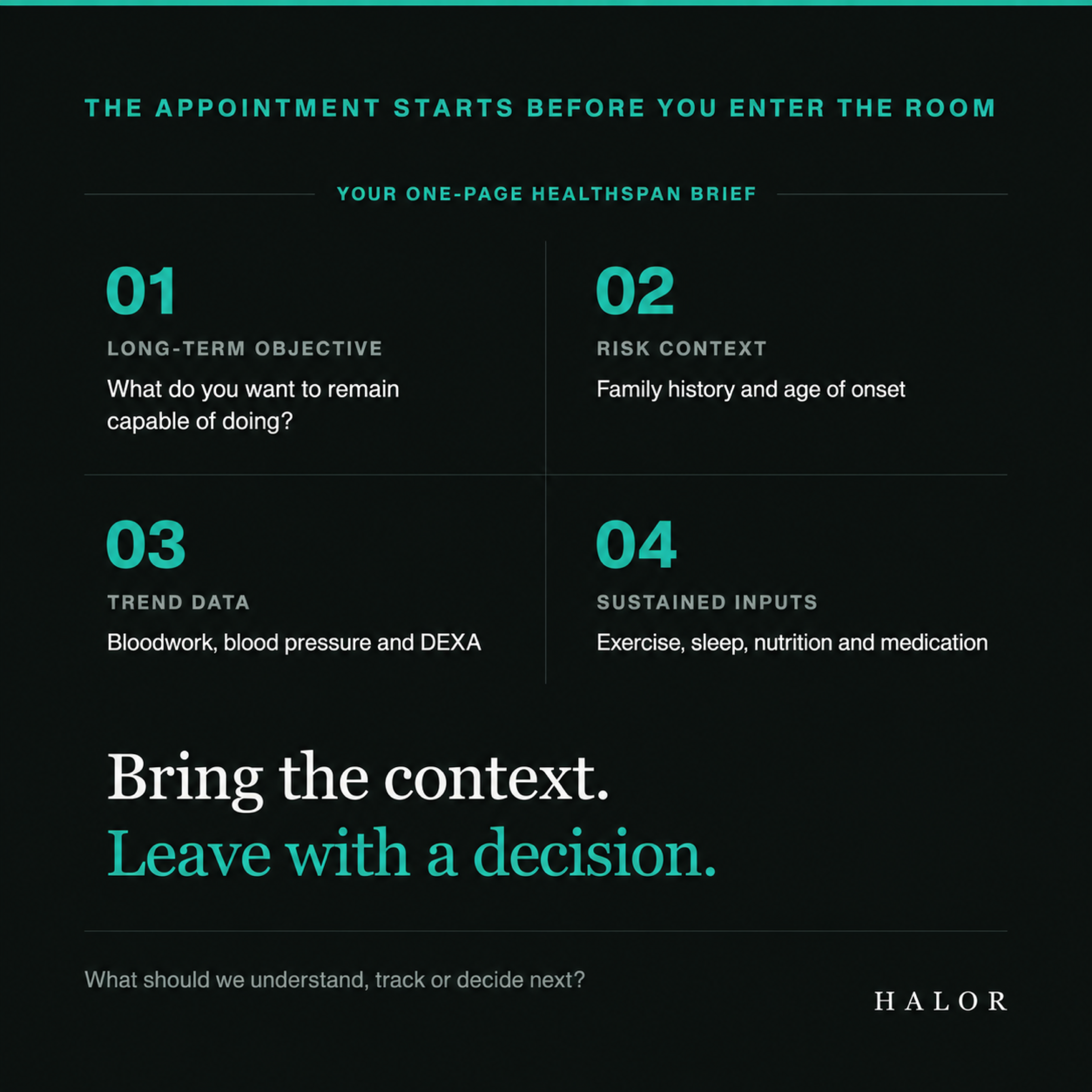
Start with four things.
Your long-term objective. What do you want to remain capable of doing in your 60s, 70s and 80s? Running your business, making complex decisions, travelling to meet customers, mentoring founders, and having the energy for family when the working day ends? Define the physical and cognitive capacity those activities require. Give prevention an outcome to protect.
Your risk context. Which diseases appear in your family, and at what age? Early disease in a close relative, especially despite a healthy lifestyle, may change the questions worth asking.
Your trend data. Put your bloodwork and blood-pressure readings side by side. If you have a DEXA scan, include muscle, visceral fat and bone-density results. A sequence of results provides context that one snapshot cannot.
Your sustained inputs. What have you consistently been doing with exercise, sleep, nutrition and prescribed medication? Include what changed, and for how long.
A focused healthspan cockpit can help organise the data:
- Cardiovascular risk and inflammation: ApoB, Lp(a), TG/HDL-C ratio, blood pressure, hs-CRP and homocysteine.
- Metabolic health: fasting insulin, fasting glucose, HOMA-IR and HbA1c.
- Liver and kidney health: ALT, AST, GGT and cystatin C-based eGFR.
- Nutrient and iron status: vitamin D, ferritin and the Omega-3 Index.
- Body composition: appendicular lean mass index, visceral fat and bone mineral density.
This is a framework for organising relevant results. Your physician can help decide which measures you need and how often.
Halor’s free beta brings this information together. Track your biomarkers and body composition over time, then use the physician appointment preparation tool to organise your goals, risk context, trends and questions. The aim is to arrive at your next appointment with a clear picture and a focused agenda.
Download the free Halor beta on TestFlight →
A reference range is not automatically your personal target.
For some markers, prevention goals may differ from the lab’s range. For others, the useful task is understanding the result and its cause.
Ask:
“Given my history and risk, which results need a personal target, and which need further interpretation?”
Then choose your top one or two priorities. Let them emerge from your goals, family history, changing results and what can be acted on now.
Turn each into a decision question:
“What should we understand, track or decide next?”
Before your next appointment, write down your long-term goal, relevant history, key trends, what you have already tried, and the two questions you most want answered.
That gives your physician something useful to work with, and gives the next step an owner.
— Ben
P.S. Which part of a one-page health brief would be most useful to you: goals, family history, trend data or questions? Reply with one word. I read every response, and your answers help shape what I write next.
Was this forwarded to you? Subscribe here → halor.app
Halor publishes educational content about health, healthspan, Medicine 3.0 and longevity. This is not medical advice and does not establish a physician-patient relationship. Always consult a qualified healthcare provider before changing your diet, exercise, supplements, medications, or screening plan. Never disregard professional medical advice, or delay seeking it, because of something you read or used here. Full disclaimer: halor.app/disclaimer.
The Healthspan Brief lands every Saturday. Subscribers get early access to Halor’s free healthspan app and help shape what we build next.
Join the Brief + get beta access