The Healthspan Brief · Issue 12 · 4 October 2026
Every supplement bottle needs a job
A practical way to audit your supplement stack, plus eight options with evidence for specific uses.
Ask founders and operators about healthspan, and supplements come up in almost every conversation.
“What are you taking?”
“Which ones are worth it?”
“Is there anything I’m missing?”
The answers tend to come with conviction. The evidence is usually more specific: a supplement may work for a particular purpose, in a particular person, at a studied dose.
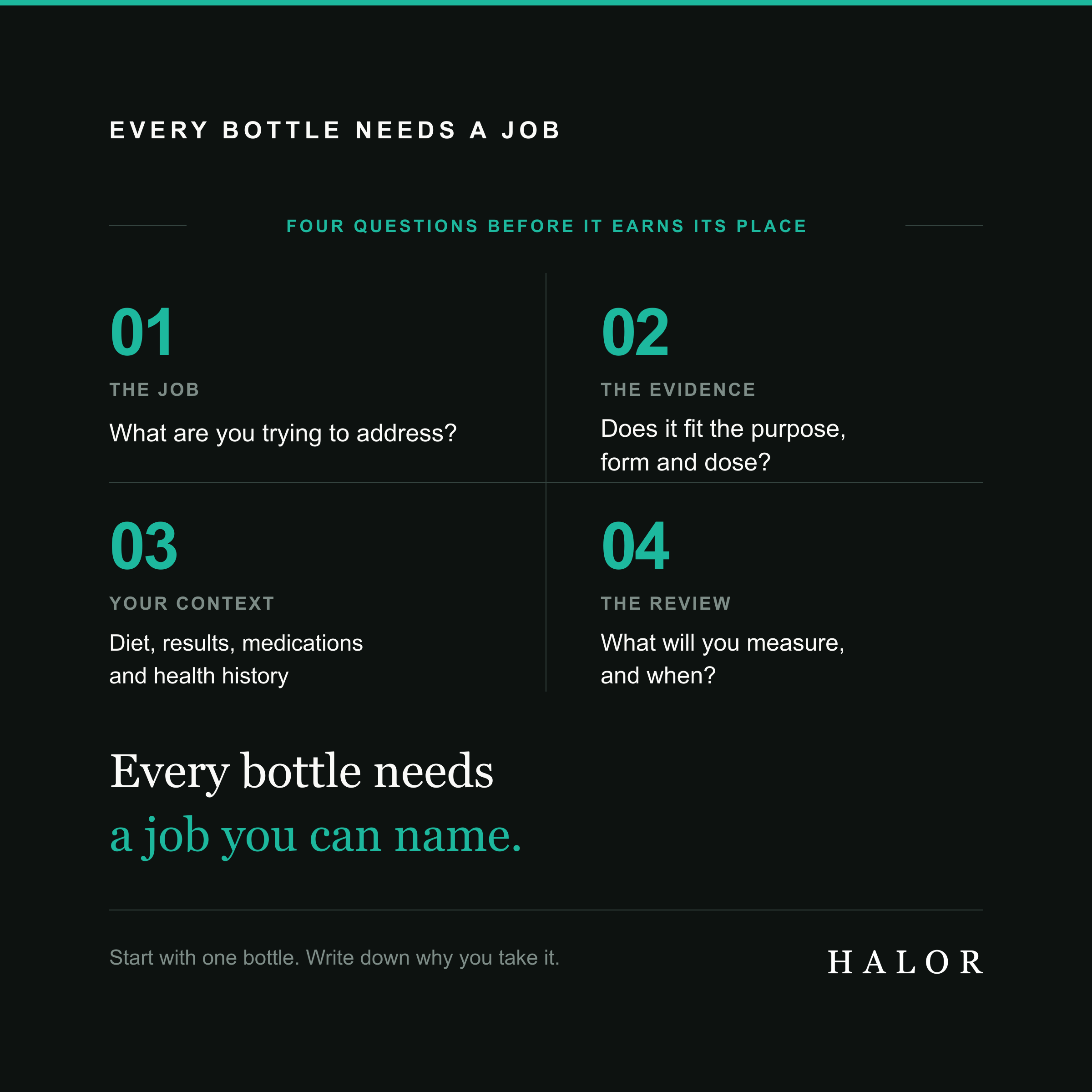
I find it useful to treat each bottle like a small investment. Before it earns a place in the stack, it needs a thesis:
- What is its job? Name the deficiency, outcome or risk you want to address.
- Does the evidence fit that job? Check who was studied, which form was used and what improved.
- Why is it relevant to you? Consider your diet, results, medications and health history.
- How will you review it? Choose an outcome, a review date and a reason to stop.
That last step is easy to skip. A bottle can stay in the cupboard for years because nobody made a decision about it again.
Halor’s Supplement Overview places eight entries in its Strong Evidence tier. Each has a different job:
- Creatine monohydrate: Helps resistance training translate into greater strength and lean mass. Take 5 grams daily alongside consistent strength training.
- Vitamin D3: Supports calcium absorption and bone health. Check 25-OH vitamin D, correct a low result, then retest and move to a maintenance dose once you are in range.
- Magnesium: Supports energy production, insulin signalling, muscle function and bowel regularity. Review your diet and medications, then choose the form according to the job. Different forms suit magnesium replacement, constipation or exercise-related cramping.
- Vitamin B12: Supports red blood cell formation, nerve health and homocysteine metabolism. If you eat little or no animal food, take metformin, have absorption issues or are over 60, ask your physician about testing B12. If the result is borderline, a methylmalonic acid (MMA) blood test can help clarify your B12 status. Kidney function can also affect MMA levels.
- Folate / methylfolate: Supports DNA synthesis and homocysteine metabolism. Consider it when folate is low or homocysteine is elevated. Check B12 first: high-dose folate can correct the anemia caused by B12 deficiency without treating its nerve effects. That can make the deficiency harder to spot while nerve problems continue.
- Zinc: Supports immune function, wound healing and hormone production. Use it to correct low intake or deficiency. If you take higher-dose zinc over time, a zinc-and-copper combination can help address zinc’s effect on copper absorption.
- Iron: Restores haemoglobin production, oxygen transport and exercise capacity when iron stores are low. Check ferritin and related blood markers, identify why the iron is low, then replace it and track the response.
- Omega-3 (EPA/DHA): Most useful for raising a low Omega-3 Index or lowering elevated triglycerides. Measure the relevant marker, check the product’s actual EPA and DHA content, and reassess the result rather than judging it by the amount of “fish oil” on the label.
These are eight tools with defined jobs, not a universal stack. Your results, goals and physician help determine which ones belong in yours.
This week’s assignment: audit one bottle.
Pick the supplement you take most automatically. Write down its job, why you started, what would show it is helping and when you will review it.
If you cannot answer those questions, bring the bottle and your notes to your next physician appointment.
Halor’s free beta includes a Supplement Overview and tracker to help you keep that record.
— Ben
P.S. Which supplement in your stack would you most like to understand better? Reply with its name.
Was this forwarded to you? Subscribe here → halor.app
Halor publishes educational content about health, healthspan, Medicine 3.0 and longevity. This is not medical advice and does not establish a physician-patient relationship. Always consult a qualified healthcare provider before changing your diet, exercise, supplements, medications, or screening plan. Never disregard professional medical advice, or delay seeking it, because of something you read or used here. Full disclaimer: halor.app/disclaimer.
The Healthspan Brief lands every Saturday. Subscribers get early access to Halor’s free healthspan app and help shape what we build next.
Join the Brief + get beta access