The Healthspan Brief · Issue 14 · 17 October 2026
Your family history is a screening tool. Most people never use it.
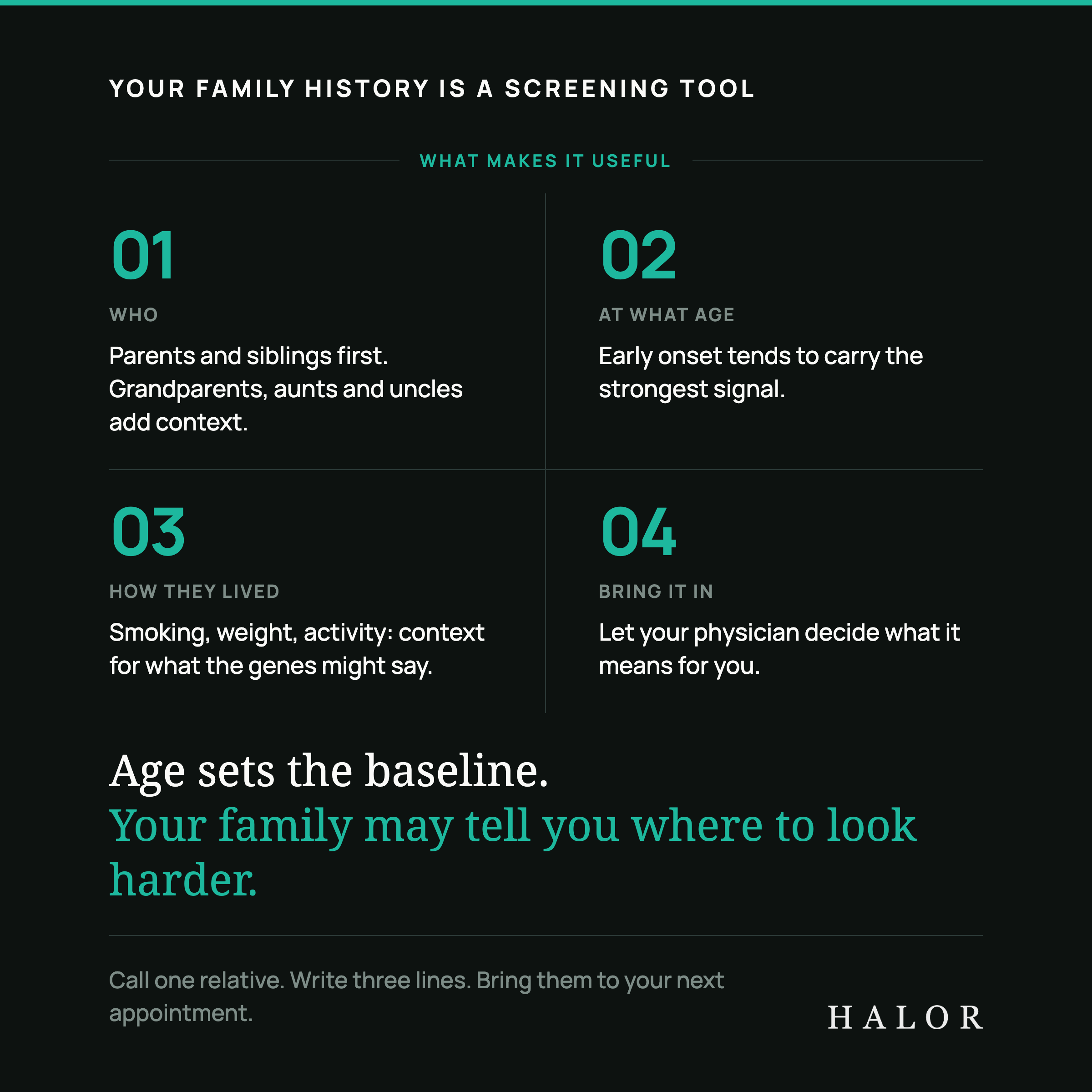
Age sets the baseline. Your family may tell you where to look harder.
A cancer diagnosis in my close family sent me into long conversations with my doctor and with friends who are physicians.
I expected to come away with a test to order. Instead, I came away with a tool I had overlooked: a careful family history.
What I heard, again and again, was that age and lifestyle drive most chronic disease risk. Genetic predisposition matters too. The question is how to read it.
In Issue 02, I called family history one of the tools that aim the camera. This week, I want to share how I’ve started putting it to work.
Age sets the baseline. Family may change the intensity.
As I understand it, the plan for most people starts with age: which diseases are most common in your decade, and which screenings are standard at your stage of life.
Family history rarely changes that plan. What it can change is how early you start, how often you check and which conversations are worth having with your physician.
Issue 04’s Lp(a) is the example I keep coming back to: a largely inherited risk that lifestyle can’t lower, and a reason to take everything else more seriously.
What made my family history more useful
A list of diseases in the family was a start. Three details made it something my doctor could actually work with:
- Who. Parents and siblings seem to carry the strongest signal. Grandparents, aunts and uncles add context.
- At what age. Early onset appears to matter most. Heart disease in a father before 55 or a mother before 65 is a commonly used flag. So is cancer in a parent or sibling at a younger age than usual.
- How they lived. A heart attack at 54 in a heavy smoker may say less about your genes than the same event in someone who did everything right.
One point that stayed with me: an unknown history is a gap, not a clean record.
Where it can change the conversation
In my conversations, the examples came up again and again: cancer in a parent or sibling, especially at a younger age, could mean starting some screenings earlier, and early heart disease was a reason to ask about ApoB, Lp(a) and possibly imaging of the heart’s arteries. Which of these apply to you is a conversation for your physician.
Genes are probability, not destiny
A family pattern can raise the odds, but it doesn’t seem to settle the outcome. A well-taken family history, discussed with my doctor, has given me more to act on than I expected. My own screenings are still a work in progress.
A consumer DNA kit now feels like a weak substitute. That doesn’t mean genetic testing has no place. As I understand it, it works best as a second step: when your family history shows a pattern, a targeted test, chosen with your doctor, can look more closely at what the pattern might mean.
This week’s assignment: three lines
Call one parent or older relative this week. For each close family member, try writing down:
- Any serious diagnosis
- The age it appeared
- One line on how they lived
Bring it to your next appointment and let your physician decide what it means for you.
Halor’s free beta includes a Family History tracker. It records relatives, conditions, ages and lifestyle context, and adds them to your appointment brief.
— Ben
P.S. How much do you know about your grandparents’ health? Reply with one word: none, some or most.
Was this forwarded to you? Subscribe here → halor.app
Halor publishes educational content about health, healthspan, Medicine 3.0 and longevity. This is not medical advice and does not establish a physician-patient relationship. Always consult a qualified healthcare provider before changing your diet, exercise, supplements, medications, or screening plan. Never disregard professional medical advice, or delay seeking it, because of something you read or used here. Full disclaimer: halor.app/disclaimer.
The Healthspan Brief lands every Saturday. Subscribers get early access to Halor’s free healthspan app and help shape what we build next.
Join the Brief + get beta access