The Healthspan Brief · Issue 15 · 24 October 2026
Cancer screening is a priority list, not a checklist.
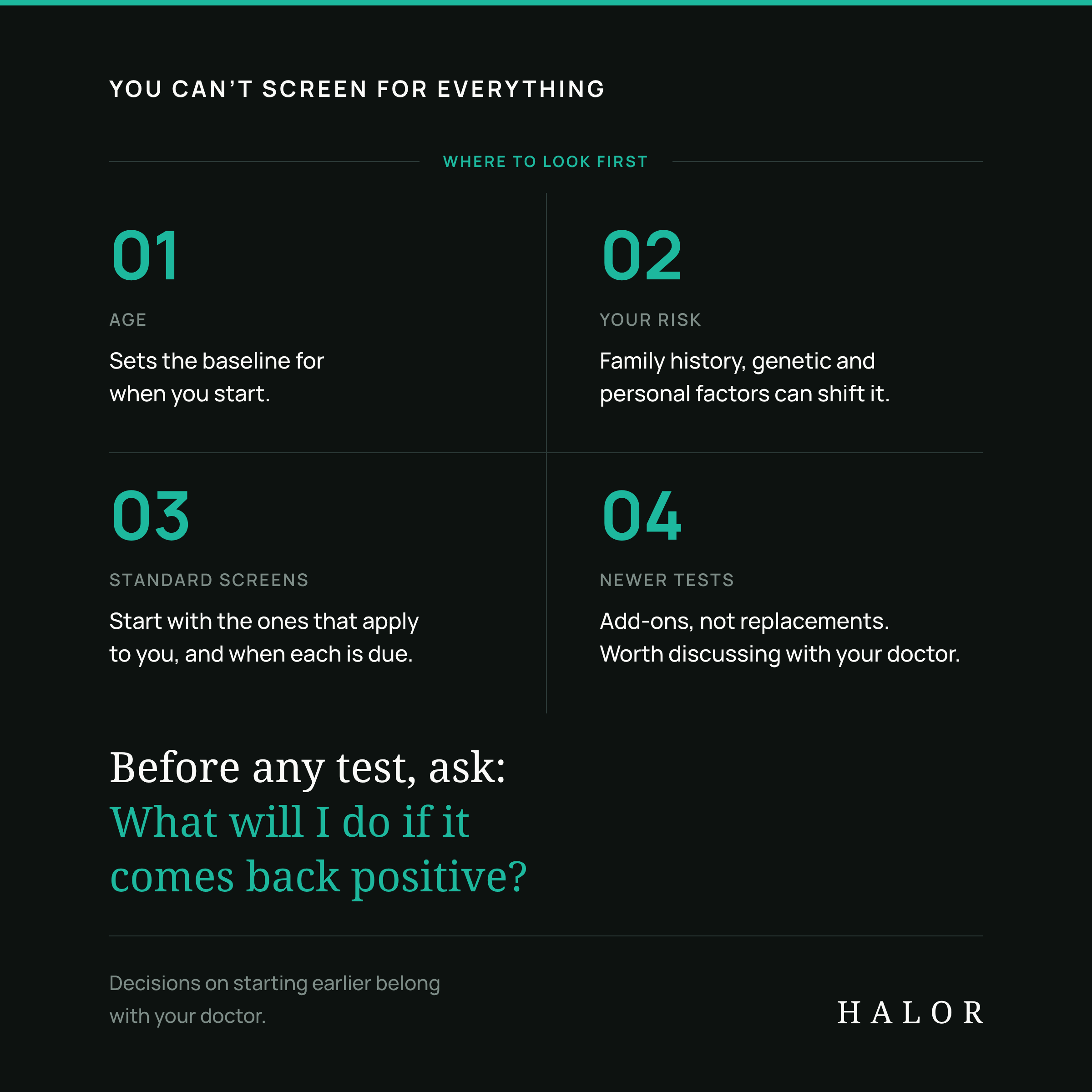
You can't screen for everything. Age sets the starting point; your personal risk shifts it.
Last week, I wrote about family history as a screening tool. This week, I want to follow it to where it usually leads: cancer screening. As always, I’m not a physician. This is what I’ve learned, and the questions it has given me for my doctor.
A cliff, not a slope
As I understand it, most cancer deaths come from metastasis, when a cancer spreads. Screening is about catching the fire while it’s still in one room. Symptoms are a late signal.
The drop is steep. In US data, colorectal cancer caught while still localized has about 91% five-year survival. Once it has spread to distant organs, that falls to about 17%. Numbers vary by country, but the pattern holds.
You can’t screen for everything
Three questions set the priorities. How likely is this cancer? How bad is it if found late? Is there a tool that finds it early enough to change the outcome?
Age sets the baseline. Your personal risk shifts it.
Age is the biggest driver of cancer risk. What moves you off that baseline is your own risk profile, and it’s built in layers.
Family history is the first layer and costs nothing. The strongest signal is cancer appearing unusually early in a close relative. An unknown history is a gap, not a clean record.
Genetic testing comes next, when your family history points there. Some inherited variants raise risk enough to bring screening forward by a decade or more. Most common cancer risk, though, comes from many genes acting together, so a clean consumer DNA report is not a clean bill of health.
Your own body and history make up the rest: what you’ve been exposed to at home and at work, smoking, a previous cancer, your ancestry, your metabolic health.
Together, these rarely change whether you screen. They change when you start, how often you check, and which tools you use.
Six cancers, and what you can do about each
These six are examples, not a complete list by any means. Screening doesn’t do the same job for every cancer. For some it can prevent the disease. For others it catches it early, and for a few there’s no good test yet. Most of the ages below come from US guidance and differ by country.
-
Colorectal: you can prevent it. It usually starts as a harmless polyp that takes years to turn. A colonoscopy can find and remove that polyp in the same procedure. The usual starting age is 45. A parent or sibling diagnosed young can move it earlier.
-
Breast: you can catch it early, and you can ask what your mammogram might miss. In some women, breast tissue and tumours look alike on a mammogram, so an ultrasound or MRI can be added. Guidance differs on whether routine mammograms start at 40 or 45. If a close relative was diagnosed young, a risk assessment may put you in a higher-risk group, where screening can start as early as 30.
-
Prostate: you can track more than a single number. Most prostate cancers grow slowly; a few are aggressive. A single PSA blood test is a snapshot. Two things tell you more: how fast PSA rises over time, and how high it is relative to the size of the prostate. Most guidance puts a first PSA, the baseline, at 45 to 50. If you’re at higher risk, for example through family history or an inherited risk, some guidance moves that to 40 to 45.
-
Lung: you can ask whether you qualify. In the US, a yearly low-dose CT scan is recommended from 50 to 80 for people with a long smoking history. However, those guidelines leave out people who never smoked.
-
Pancreatic: know whether it runs in your family. There’s no routine screening test for most people. For the few at clearly higher risk, usually because of a strong family history or a known inherited risk, surveillance is something a specialist decides on.
-
Melanoma: you can have your skin checked. The check is a yearly full-body skin exam by a dermatologist using a magnifying scope.
The newer tests: add-ons, not replacements
Multi-cancer blood tests, a type of liquid biopsy, look for tumour DNA from a single draw. Whole-body MRI looks at organs that have no standard screen. Both can add a useful layer on top of the standard screens. They’re best used alongside them, not instead of them, and they’re worth discussing with your doctor.
Two things can go wrong. A negative result doesn’t rule out early cancer. And a positive one isn’t a diagnosis. If you’re 45 and healthy, many flagged results turn out not to be cancer, and checking them can mean more scans, sometimes a biopsy, and weeks of worry. So before any test, ask: what will I do if it comes back positive?
Questions I’d take to the appointment
-
Which screenings apply to me, and when is each due?
-
Given my family history, and any genetic or other personal risk factors, should I start earlier or check more often?
-
For each newer test: yes, no or not yet? What would a positive result trigger?
This week’s assignment: your screening one-pager
Write down every cancer screening you’ve had, with the test, the date and the result.
— Ben
P.S. Do you know when your last cancer screening was? Reply with one word: yes, roughly or no.
Was this forwarded to you? Subscribe here → halor.app
Halor publishes educational content about health, healthspan, Medicine 3.0 and longevity. This is not medical advice and does not establish a physician-patient relationship. Always consult a qualified healthcare provider before changing your diet, exercise, supplements, medications, or screening plan. Never disregard professional medical advice, or delay seeking it, because of something you read or used here. Full disclaimer: halor.app/disclaimer.
The Healthspan Brief lands every Saturday. Subscribers get early access to Halor’s free healthspan app and help shape what we build next.
Join the Brief + get beta access