The Healthspan Brief · Issue 16 · 31 October 2026
Would you want to know?
One test can hint at your brain's future. The harder question is whether you want the answer.
The last two weeks were about finding problems early. The brain is harder. As always, I’m not a physician. This is what I’ve learned, and the questions it’s given me for my doctor.
Why I care about this one
For founders and operators, the brain is the job. Judgement, focus, memory for people and deals, and the stamina to make hundreds of decisions a week are what we actually get paid for. Yet most of us treat it the way we treat our sleep: something to borrow against until the company is in better shape.
What struck me is that the habits that protect the brain in your 70s are the same ones that keep you sharp at work today. That makes it one of the rare kinds of prevention with a payoff you can feel now, not just decades later.
It starts long before you notice
As I understand it, Alzheimer’s builds for years, often decades, before memory slips. That makes it a prevention problem long before it’s a medical one.
What’s thought to go wrong
There’s no single cause, but three processes keep coming up.
-
Blood flow. The brain runs on a dense network of tiny vessels. Over the years, silent small strokes and poor circulation can starve neurons of oxygen.
-
Energy. The brain is the body’s most energy-hungry organ. When the body stops handling blood sugar well, the brain goes short too.
-
Clean-up. The brain clears out waste proteins linked to Alzheimer’s (amyloid and tau), mostly during deep sleep.
One gene, one question
There’s a gene called ApoE, and one version of it, E4, is the strongest known genetic risk factor for the common form of Alzheimer’s. One copy raises your risk, and two raise it more. E4 seems to make the brain’s clean-up harder, and it makes everyday risks like high blood pressure or poor blood sugar hit harder.
But it’s a warning label, not a destiny. E4 shifts the odds; it doesn’t decide the outcome for certain. Many carriers never develop Alzheimer’s, and some people who don’t carry it still do.
A result gives you odds, not your future, and it can weigh on you. If you’re curious, talk it through with your doctor first.
Why these four matter
-
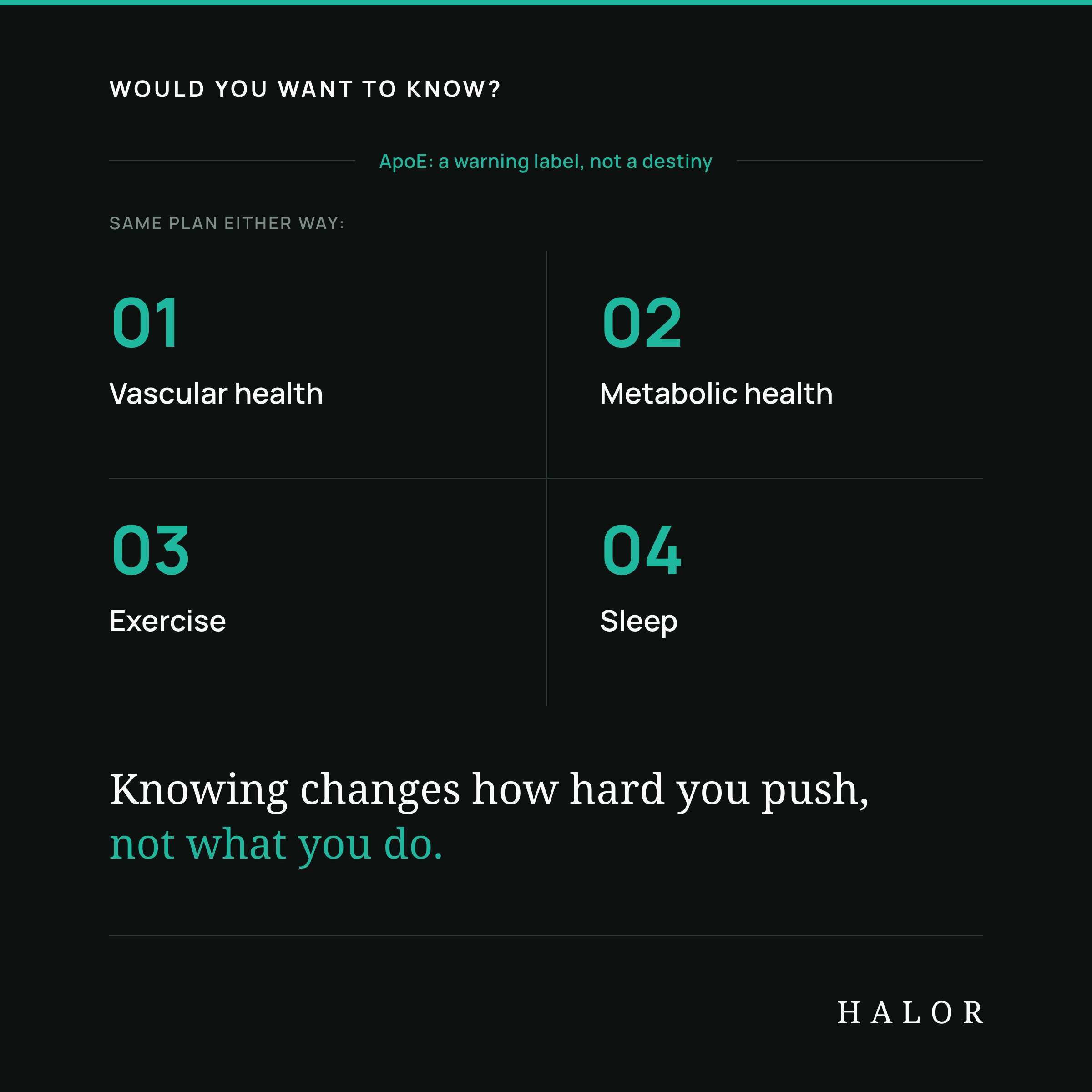
Vascular health protects the blood supply. Blood pressure is the big one, a front-line brain intervention as well as a heart one. The same cholesterol particles that clog heart arteries also damage the brain’s tiny vessels, so keeping lipids in check matters here too.
-
Metabolic health keeps the fuel flowing. The insulin resistance that strains the heart also starves neurons.
-
Exercise may protect the brain more than any other single lever. It improves how cells make energy and how the body handles blood sugar. The ideal is a mix of steady cardio, harder efforts and strength work, at whatever intensity your doctor clears.
-
Sleep is when the clean-up happens, and most adults need seven to nine hours. Alcohol undercuts it more than most people think.
The plan doesn’t change
Whatever your ApoE result, the plan is the same four levers. Knowing changes how hard you push, not what you do. And unlike most prevention, you’ll feel this one at work long before it shows up anywhere else.
So the real question isn’t “should I get tested?” It’s “what would I do differently with the answer, and am I ready for either result?” Saying no is a fair choice.
Questions I’d take to the appointment
-
Given my family history, is ApoE worth discussing for me?
-
Whatever my status, how am I doing on vascular health, metabolic health, exercise and sleep?
-
If I did test, what would we do differently with either result?
This week’s assignment
Add one line to your Issue 14 family-history page: has anyone in your family had dementia, and at what age did it start? Family history often tells you as much as a gene test.
— Ben
P.S. Would you want to know your ApoE status? Reply with one word: yes, no or unsure.
Was this forwarded to you? Subscribe here → halor.app
Halor publishes educational content about health, healthspan, Medicine 3.0 and longevity. This is not medical advice and does not establish a physician-patient relationship. Always consult a qualified healthcare provider before changing your diet, exercise, supplements, medications, or screening plan. Never disregard professional medical advice, or delay seeking it, because of something you read or used here. Full disclaimer: halor.app/disclaimer.
The Healthspan Brief lands every Saturday. Subscribers get early access to Halor’s free healthspan app and help shape what we build next.
Join the Brief + get beta access