The Healthspan Brief · Issue 07 · 22 August 2026
The most valuable drug in history can't be patented
It counters all four risks on the register at once — and "exercise" turns out to be four different jobs. This week: find your weakest one.
Imagine a drug that strengthens your heart, preserves muscle and bone, improves insulin sensitivity, protects the wiring of your brain, counters cancer — and cuts long-term mortality not by percentage points but by multiples.
Every pharmaceutical company on earth would chase it. None can. It can’t be patented.
It’s exercise — and it breaks the circle from last issue from two directions at once. Muscle is your body’s primary sink for blood sugar: build it, and glucose has somewhere to go without insulin having to shout. Cardiovascular fitness is the other half: it rebuilds the mitochondrial engine that burns the fuel, so the surplus that starts the circle gets used instead of stored.
The same work strengthens the blood-vessel lining that cardiovascular disease attacks. It lowers the visceral fat that last issue named as a potent modifiable cancer risk factor. It releases BDNF, a growth factor for neurons. And it loads the muscle and bone that keep you functional — which decides how long you stay on top of your game, and how long the people counting on you, at home and at work, actually can.
The mortality data is sized accordingly: in large cohort studies, moving from the bottom quartile of cardiorespiratory fitness to the top few percent for your age group is associated with multi-fold reductions in mortality risk. Multi-fold. Most things you will ever read about in health move risk at the margins.
“Exercise” is four different jobs
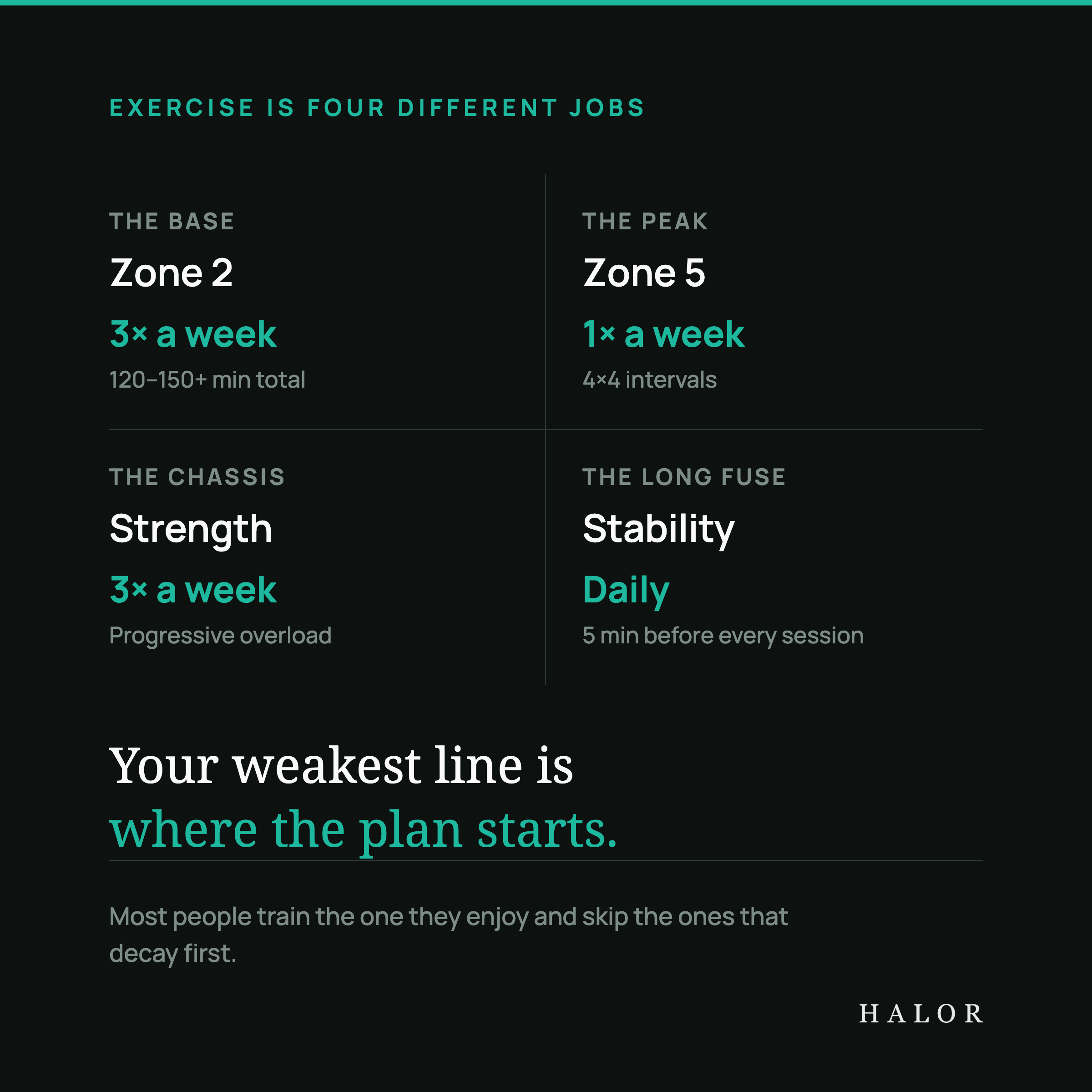
Here’s where most plans quietly fail: exercise isn’t one thing. It’s four distinct components — not interchangeable — and most people default to the one they enjoy while skipping the ones that decay first.
The base. Zone 2 — the sustained, unglamorous intensity at which your mitochondrial engine grows most efficiently. Conversational pace, but you’d rather not talk; a casual walk doesn’t reach it. The reference point is 120 to 150+ minutes a week, and it’s the foundation everything else sits on: without it, high-intensity work is a turbocharger bolted onto a weak engine.
The peak. VO2 max — your body’s maximum capacity to use oxygen, and one of the strongest predictors of long-term survival in the literature, stronger than almost any single biomarker. It sets the ceiling on everything from stairs to surgery recovery. In training terms this is Zone 5, and the research workhorse is the 4×4: four-minute intervals at around 90% of max heart rate, four times, with easy recovery between. It’s earned, not started — introduce it only once your Zone 2 base has been consistent for weeks.
Strength. Muscle is your largest endocrine organ, the glucose reservoir from above, and the tissue that secretes anti-inflammatory signalling molecules that benefit every other system. The stimulus has to be real to count: progressive overload, three sessions a week.
Stability. The one with the longest fuse. The rate of death from falling rises exponentially after 65 — and the fall itself is rarely the end of the story; the trajectory that follows usually is: immobilization, then decline. Stability and balance work in your forties and fifties is insurance against that entire cascade, and it costs five minutes a day. A rough self-check: one leg, eyes open, twenty seconds, without grabbing anything.
And the last two compound each other, which is why neither is optional: muscle pulls on bone, bone responds to that load — lose one and you lose the other. It’s why grip strength, of all things, correlates strongly with all-cause mortality in population studies. None of this is vanity. It’s whether a stumble at 75 becomes a full recovery or the hip fracture that changes your healthspan trajectory.
One boundary before any of it — the balance self-check included: if you have a family history of cardiac events, if you’re returning from a long stretch of inactivity, or if a knee, a hip, or your balance is already a concern, the conversation with your physician comes first. That isn’t bureaucratic friction. It’s what lets you train hard for the next four decades without an injury derailing the plan.
This week’s assignment: ten minutes
Audit the week you actually lived — calendar or training app, not the week you intended. Four lines:
→ Minutes of genuine Zone 2 → Number of strength sessions → Any Zone 5 work → Daily stability work
One line will be the weakest. That’s your weakest link, and it’s where the plan starts — not with more of the component you already enjoy.
And once the plan starts, a harder question appears: how do you know it’s working? The instrument you’d reach for first is the one most likely to lie to you. That’s next issue.
You’re the CEO of a decades-long project. Your physician is your highest-value consultant. Halor is the co-pilot that keeps the whole healthspan plan in front of you.
If you know someone who trains hard but only ever trains the one thing they enjoy, forward them this one.
— Ben
P.S. Which line was weakest — base, strength, peak, or stability? One word back. I have a guess about which answer will dominate, and the replies shape what gets written next.
Was this forwarded to you? Subscribe here → halor.app
Halor publishes educational content about health, healthspan, Medicine 3.0 and longevity. This is not medical advice and does not establish a physician-patient relationship. Always consult a qualified healthcare provider before changing your diet, exercise, supplements, medications, or screening plan. Never disregard professional medical advice, or delay seeking it, because of something you read or used here. Full disclaimer: halor.app/disclaimer.
The Healthspan Brief lands every Saturday. Subscribers get early access to Halor’s free healthspan app and help shape what we build next.
Join the Brief + get beta access