The Healthspan Brief · Issue 09 · 5 September 2026
The health lever you cannot outsource
Founders do not fail at sleep because they forgot the tips. They fail because sleep is where the boundary has to become real.
Most founders do not have a sleep problem.
They have a boundary problem.
That sounds harsher than I mean it. Sleep is not hard because the advice is complicated. Most people already know the basics: keep a regular schedule, dim the lights, cool the room, stop treating caffeine like water, do not use alcohol as a sleep aid.
The hard part is that sleep is the first health lever that asks you to disappoint somebody.
Exercise can be scheduled. Bloodwork can be booked. Supplements can be bought. A scan can be ordered by a physician.
Sleep is different.
Sleep asks you to close the laptop while the thread is still alive. To leave the message unanswered. To stop turning the last hour of the day into a landfill for every task that did not fit anywhere else.
And if you are a parent, it gets even less clean. A child wakes up. Someone is sick. The evening collapses. The day does not end when the calendar says it should.
I learned that the slow way after my daughter was born. Sleep fragmented, meals became whatever was fast, training disappeared, and none of it felt like a decision. It became the metabolic drift I wrote about in Issue 06: weight up, waist up, bloodwork sliding, all without one dramatic event to force the issue.
That is why sleep is so easy to misfile.
A bad night does not feel like a disease process. It feels like life.
What sleep is upstream of
But sleep sits upstream of almost everything founders claim to care about: glucose handling, appetite, training recovery, cognitive performance, mood, and patience with the people who get the least edited version of you.
That last one is not a lab marker, but every parent knows it is real.
For years, I understood sleep as recovery. Useful, obviously. Important, sure. But still filed under “nice if possible.”
Then I wore a CGM and watched the same breakfast behave differently after different nights of sleep. The point is not that everyone needs a glucose monitor. The point is that “sleep matters” stopped being a slogan and became a number I could watch move.
Measurement is not governance
Measurement helps. But measurement is not the hard part.
Founders love measurement because measurement feels like control. The ring score. The HRV trend. The bedtime average. The sleep-stage graph.
Useful, up to a point.
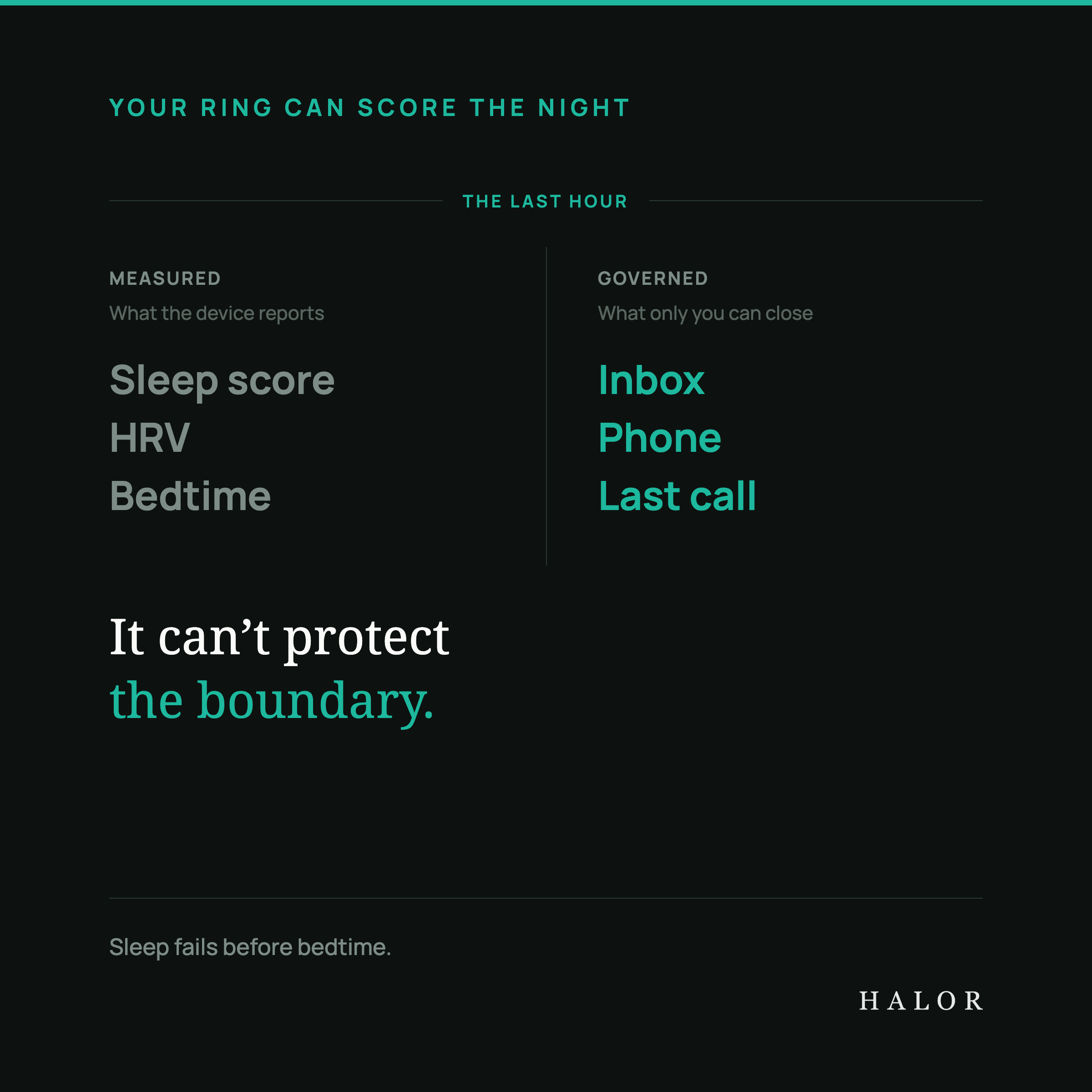
The harder question is more basic:
Who owns your last hour?
If your last hour belongs to Slack, your inbox, the board deck, Netflix, revenge bedtime procrastination, or the second glass of wine, the sleep protocol has already lost before it starts.
One boundary, not a perfect routine
So the operator move is not to build a perfect sleep routine. Perfect routines die on contact with children, travel, fundraising, illness, and life.
The move is to protect one boundary that survives a messy week.
A fixed wake time. A caffeine cutoff. The phone out of the bedroom. A protected downshift hour twice a week. A rule that non-urgent work threads wait until morning.
One thing small enough to survive reality, but real enough that your body notices.
And one physician question belongs here too: if you give yourself enough time in bed but still wake unrefreshed, snore loudly, or feel chronically tired during the day, ask whether sleep apnea should be ruled out. Lean, fit people can have it too, and no amount of sleep hygiene fixes disrupted breathing.
This week’s assignment: name the boundary
This week, do not try to become a monk.
Pick the sleep boundary you are most likely to break, and write down who or what usually breaks it.
That is the diagnostic.
Not “do I know how to sleep better?”
“Who gets to spend my sleep before I do?”
— Ben
P.S. What most reliably steals your sleep right now: work, kids, stress, travel, or your own wiring? Reply with one word.
Was this forwarded to you? Subscribe here → halor.app
Halor publishes educational content about health, healthspan, Medicine 3.0 and longevity. This is not medical advice and does not establish a physician-patient relationship. Always consult a qualified healthcare provider before changing your diet, exercise, supplements, medications, or screening plan. Never disregard professional medical advice, or delay seeking it, because of something you read or used here. Full disclaimer: halor.app/disclaimer.
The Healthspan Brief lands every Saturday. Subscribers get early access to Halor’s free healthspan app and help shape what we build next.
Join the Brief + get beta access