The Healthspan Brief · Issue 08 · 29 August 2026
The three numbers your scale can't show you
Muscle mass. Visceral fat. Bone density. The body-composition scoreboard your bathroom scale cannot give you.
“I’ve put on a bit.”
For the drift years, that sentence was my entire body-composition analysis — one bathroom-scale number. Then a single scan gave me three numbers that mattered, and the gap between those two sentences is this issue.
Last issue ended on a question: once the training starts, how do you know it’s working?
The answer starts with choosing the right outcome. The surprise is that it isn’t your weight. The target is optimized body composition. In practice, that means three numbers: muscle mass, visceral fat and bone density. Weight, BMI and waist-to-height are surrogates. They infer what may be happening underneath. A precision approach aims at those three numbers directly.
The target is body composition
Step on a scale and you get one figure: everything your body contains added together, including muscle, bone, organs, water and fat. The total includes both the fat under your skin and the visceral fat from Issue 01 packed around your organs. The scale cannot separate any of it.
A total can’t tell you which part moved. Weight down can be bad news: muscle lost. Weight flat can be excellent news: muscle up, fat down. Months of resistance training can read as “gained weight.” A hard block that moves fat down and muscle up can read as “nothing happened,” the exact outcome you were training for.
BMI is the same total, corrected for height: built for studying populations, blind to composition for the individual. A “normal” BMI can sit on top of high visceral fat and low muscle at the same time. That’s the TOFI phenotype — Thin Outside, Fat Inside — the marathoner from Issue 01 with a BMI of 22 and visceral fat in the 90th percentile.
The tape measure is one step better aimed. Waist-to-height, which many practitioners use as a first conversation starter, at least points at where the fat sits. But it is still an estimate from outside. It can’t separate the fat under your skin from the fat around your organs, and it says nothing about muscle or bone.
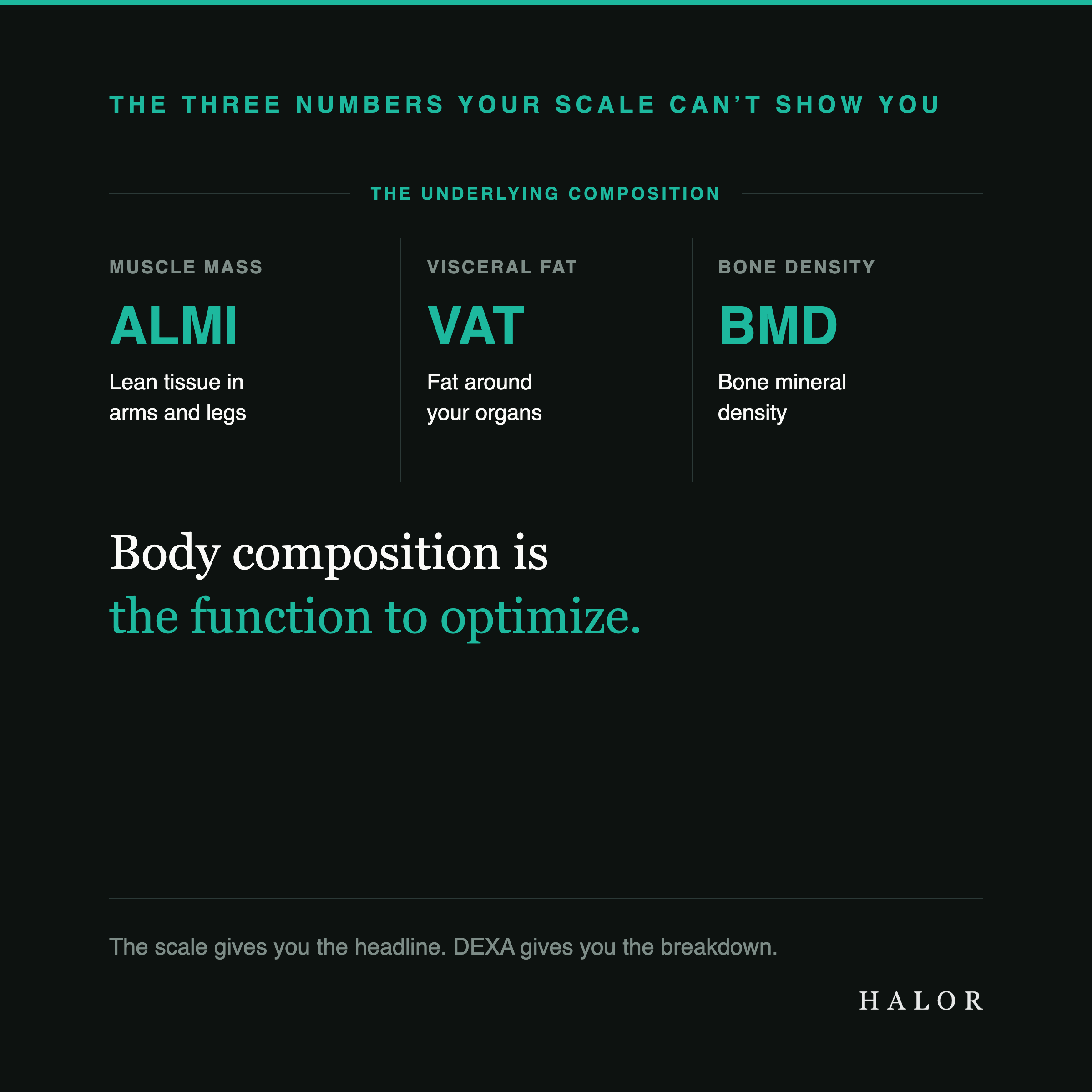
Weight, BMI and waist-to-height are useful surrogates, not the function to optimize. Body composition is.
No operator would run a company from one top-line number. Revenue can rise while margins fall. The headline tells you something changed; the management accounts tell you what changed. Weight is the headline number. DEXA gives you the underlying composition.
The three-number scoreboard
DEXA takes the total apart. A whole-body scan gives you the three lines this issue is built around.
Muscle mass. Focus on appendicular lean mass index, or ALMI: the lean tissue in your arms and legs, adjusted for your height.
Visceral fat. Compatible DEXA systems can estimate the fat around your organs separately from the fat under your skin.
Bone density. The same scan measures bone mineral density. Your weight can move up, down or nowhere while bone density changes underneath it.
Together, those three readouts describe body composition with far more resolution than body weight. Repeat the DEXA scan under comparable conditions, and that baseline becomes a trend.
Precision comes from measuring the right outcome on a useful cadence. A bathroom scale can generate hundreds of readings a year with limited signal. A DEXA repeated every six to twelve months, on the same machine and under comparable conditions, can show whether its three readouts are moving in the intended direction.
Whether DEXA belongs in your plan, how often to repeat it, and which thresholds matter for you are decisions to make with your physician.
This week’s assignment: save one question
For your next appointment: “Is a DEXA scan the right tool for my stage? If so, which readouts and thresholds matter for me, and how often should I repeat it?”
You’re the CEO of a decades-long project. Your physician is your highest-value consultant. Halor is the co-pilot that keeps the whole healthspan plan in front of you.
If you know someone whose entire health dashboard is a bathroom scale, forward them this one.
— Ben
P.S. Which number is missing from your current health dashboard: muscle mass, visceral fat or bone density? Reply with one. The answers shape what gets written next.
Was this forwarded to you? Subscribe here → halor.app
Halor publishes educational content about health, healthspan, Medicine 3.0 and longevity. This is not medical advice and does not establish a physician-patient relationship. Always consult a qualified healthcare provider before changing your diet, exercise, supplements, medications, or screening plan. Never disregard professional medical advice, or delay seeking it, because of something you read or used here. Full disclaimer: halor.app/disclaimer.
The Healthspan Brief lands every Saturday. Subscribers get early access to Halor’s free healthspan app and help shape what we build next.
Join the Brief + get beta access